

Subject knowledge
English and maths priorities, with agreed science topics where suitable. Address gaps and practise applying learning.
Secondary learning · KS3–KS4
Focused secondary tuition and personalised provision that help learners reconnect with subjects, develop secure foundations and work towards an appropriate education pathway.
Discuss the right support →Ask a question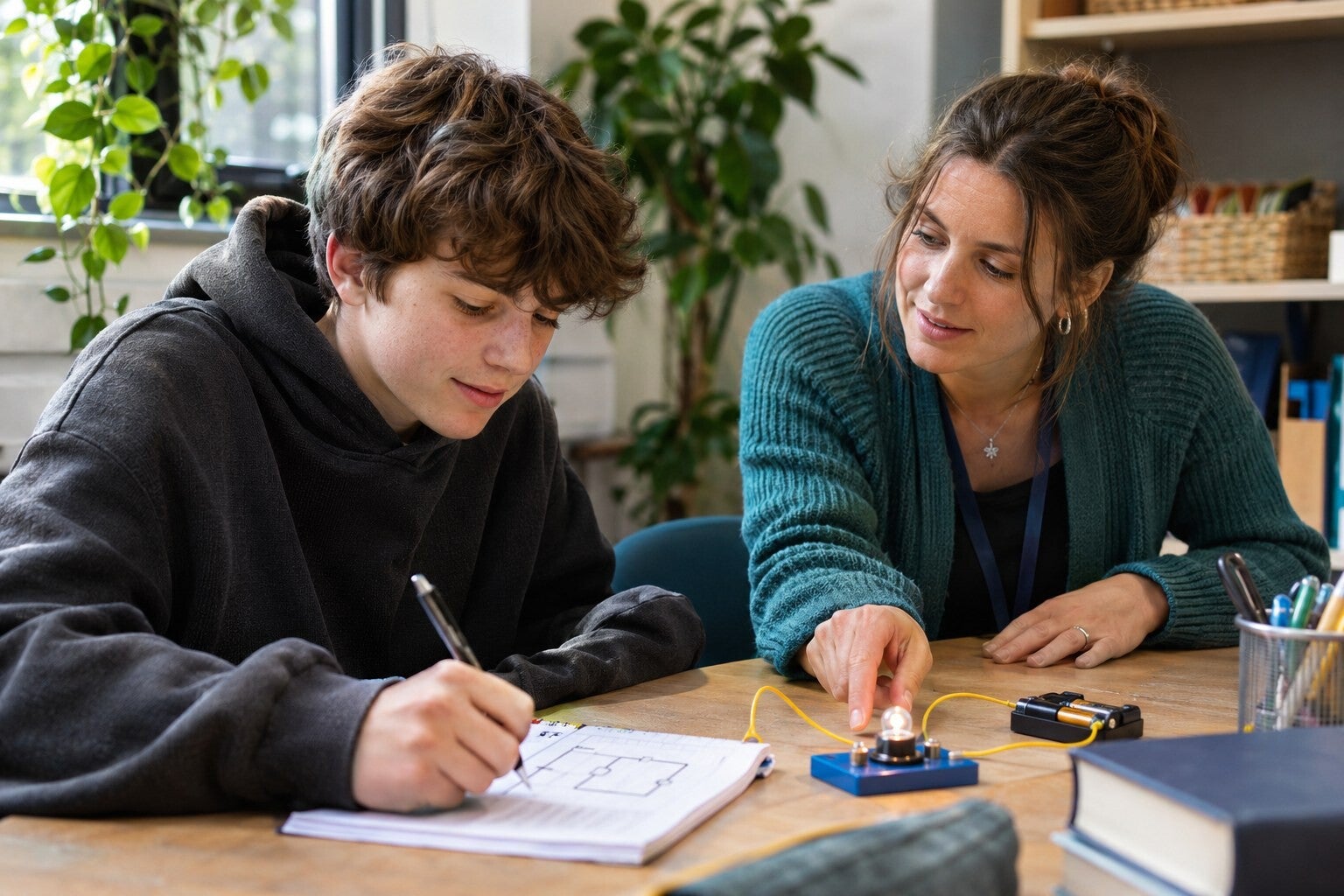
A purposeful programme
A learner may need to rebuild subject knowledge, prepare for assessments or re-establish a learning routine. We agree the priorities with the learner and referrer, keeping education goals visible throughout the programme.
English and maths priorities, with agreed science topics where suitable. Address gaps and practise applying learning.
Manageable tasks, explanation and feedback, with support to ask questions and work more independently.
Connect tuition to the learner’s course, next setting and qualification plans where appropriate.
An example in practice
A practical science task can lead into subject vocabulary, interpreting results and answering a related question. The tutor checks understanding as the learner works, rather than judging progress by completed pages alone. Activities are adapted individually.
CORE SUBJECTS · KS3–KS4
English and maths remain central, with science topics included where suitable and agreed. Teaching can revisit earlier learning, develop subject confidence or support the learner's current course and assessment priorities.
KS3 examples: reading fiction and non-fiction, explaining ideas with evidence, vocabulary and structured writing. KS4 examples: analysing language, comparing texts and planning clear written responses linked to the agreed course.
KS3 examples: number, fractions, percentages, ratio, introductory algebra, geometry and data. KS4 examples: strengthen algebra and proportional reasoning, interpret graphs and statistics, and practise multi-step problems at an appropriate level.
Agreed biology, chemistry or physics topics might include cells and body systems, particles and materials, or forces, energy and electricity. Learning can include scientific vocabulary, interpreting results and explaining conclusions from evidence.
Topics are illustrative, not a promise of full course coverage. For KS4, the subjects, specification, exam board and tier are agreed individually. Existing exam-entry and centre arrangements remain a separate discussion.
Clarity before provision starts
KS3 or KS4 teaching linked to agreed subjects, current knowledge and curriculum priorities.
Individual teaching, accessible tasks and regular feedback, with engagement or transition support where agreed.
GCSEs use grades 9–1. Functional Skills routes may also be appropriate. Subjects, board, tier, exam entry and centre arrangements must be agreed separately; tuition does not itself confirm exam entry.
From enquiry to review
The programme, session arrangements and review approach are agreed before provision begins. An enquiry is the start of a suitability discussion.
Share current subjects, exam board details if known, recent work and relevant support plans.
Set priorities, timetable, adjustments and review arrangements with the learner and referrer.
Review learning evidence, attendance and participation alongside transition or assessment priorities.
Safety underpins the plan. Safeguarding contacts, relevant information, adult responsibilities and safe delivery arrangements are discussed before support starts. Safer recruitment and professional boundaries matter throughout.
Safeguarding & policies →Tell us about the current education, support needs and what you would like to change. Suitability, availability and arrangements are confirmed individually.
Discuss a referral →