Published by Reconnect Learning
Choosing the right qualification can make a significant difference to a young person's confidence, engagement and future opportunities.
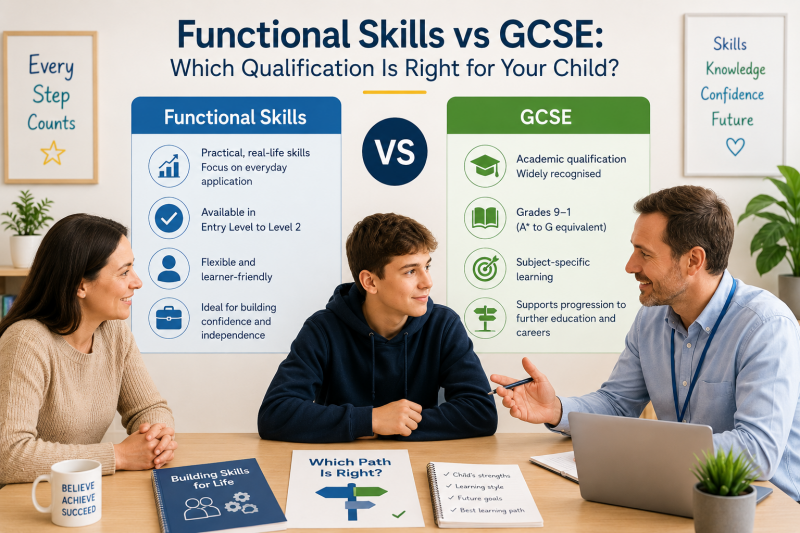
Many parents ask whether their child should study Functional Skills or GCSEs. While both qualifications are recognised and valuable, they are designed for different learners and different outcomes.
What Are Functional Skills Qualifications?
Functional Skills qualifications focus on practical English and Maths skills that can be applied in everyday life, further education and employment.
Rather than focusing heavily on academic theory, Functional Skills aims to develop real-world skills such as:
- Communication
- Problem solving
- Reading and understanding information
- Writing for different purposes
- Using Maths in everyday situations
What Are GCSE Qualifications?
GCSEs are academic qualifications typically studied in secondary school.
GCSE English and GCSE Maths involve a broader curriculum and often require learners to demonstrate deeper subject knowledge, analysis and examination skills.
GCSEs are commonly used for:
- College applications
- Sixth Form entry
- University pathways
- Apprenticeships
- Employment opportunities
Key Differences Between Functional Skills and GCSEs
| Functional Skills | GCSE |
|---|---|
| Practical learning focus | Academic learning focus |
| Everyday application | Broader curriculum content |
| Often more accessible | Can be more demanding academically |
| Levels 1 and 2 | Grades 1-9 |
| Regular exam opportunities | Mainly summer examination series |
Who Are Functional Skills Suitable For?
Functional Skills can be particularly beneficial for learners who:
- Need practical learning approaches
- Have struggled with GCSE pathways previously
- Require confidence-building opportunities
- Are preparing for employment or apprenticeships
- Benefit from smaller learning steps
Who Are GCSEs Suitable For?
GCSEs may be the right pathway for learners who:
- Enjoy academic study
- Are planning to progress to college or sixth form
- May wish to attend university in the future
- Can manage longer examination papers
- Want to achieve traditional school qualifications
Can Functional Skills Lead to Further Education?
Yes.
Functional Skills qualifications are recognised by many employers, colleges, apprenticeship providers and training organisations.
For many learners, Functional Skills provides a valuable route into employment, vocational training and further learning.
What About Learners with SEND or EBSNA?
The most appropriate qualification should always be based on the individual learner's needs, strengths and future goals.
For some learners with SEND, EBSNA or disrupted educational experiences, Functional Skills can provide an accessible and confidence-building pathway.
For others, GCSEs may remain the most appropriate route with the right support and reasonable adjustments in place.
How Reconnect Learning Can Help
Reconnect Learning supports learners studying both Functional Skills and GCSE qualifications.
Our programmes include:
- Functional Skills English
- Functional Skills Maths
- GCSE English Support
- GCSE Maths Support
- Exam Preparation
- SEND Support
- EBSNA Support
- Home Tuition
- Online Learning
- Alternative Provision
Need Advice on Qualifications?
Every learner is different. If you are unsure whether Functional Skills or GCSEs are the right option for your child, Reconnect Learning can help you explore the most suitable pathway.
Call: 01708 918728
Email: info@reconnectlearning.co.uk
Together, we can help your child achieve qualifications that support their future goals.
Add comment
Comments