Published by Reconnect Learning
If your child is struggling in school, you may have heard terms such as SEND Support, SENCO, interventions or EHCP. Understanding how SEND support works can help parents feel more confident when seeking help for their child.
Every child deserves an education that meets their individual needs. Schools have a responsibility to identify barriers to learning and provide appropriate support to help children achieve their potential.
What Does SEND Mean?
SEND stands for Special Educational Needs and Disabilities.
A child may have SEND if they have a learning difficulty or disability that makes it significantly harder for them to learn than most children of the same age.
SEND can include a wide range of needs, including:
- Autism Spectrum Condition (ASC)
- ADHD
- Dyslexia
- Speech and Language Difficulties
- Social, Emotional and Mental Health Needs (SEMH)
- Sensory Processing Difficulties
- Physical Disabilities
- Medical Needs
What Is SEND Support?
SEND Support is the help provided by a school to meet a child's identified needs without an EHCP.
Schools are expected to identify children who may require additional support and put appropriate interventions in place.
The aim is to remove barriers to learning and help children make progress alongside their peers.
What Is a SENCO?
Every school must have a Special Educational Needs Coordinator (SENCO).
The SENCO is responsible for coordinating SEND provision within the school and working with staff, families and external professionals.
Parents should feel able to contact the SENCO if they have concerns about their child's progress, wellbeing or educational needs.
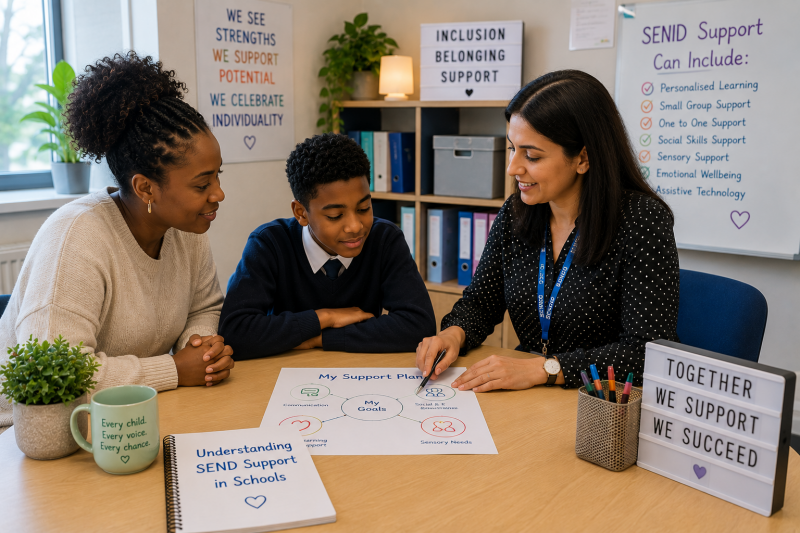
What Support Might a School Provide?
Support should always be based on the individual needs of the child.
Examples may include:
- Small group interventions
- One-to-one support
- Adapted teaching strategies
- Visual resources
- Communication support
- Social skills programmes
- Emotional wellbeing support
- Sensory adjustments
- Access arrangements
The Graduated Approach
Schools should follow what is known as the Assess, Plan, Do, Review cycle.
This means schools should:
- Assess a child's needs
- Plan appropriate support
- Deliver the support
- Review progress regularly
This process should be ongoing and responsive to the child's development and changing needs.
When Might an EHCP Be Needed?
Some children require support beyond what a school can reasonably provide through SEND Support alone.
In these cases, an Education, Health and Care Needs Assessment may be considered.
An EHCP may be appropriate when needs are significant, complex or long-term and require additional provision.
What If My Child Is Not Attending School?
Some children with SEND experience difficulties attending school due to anxiety, sensory needs, SEMH difficulties or emotionally based school non-attendance (EBSNA).
Where attendance becomes a concern, early intervention is important to prevent barriers becoming more entrenched.
Additional support, alternative provision or personalised learning pathways may need to be explored.
Working in Partnership with Schools
The most successful outcomes often happen when schools and families work together.
Open communication, shared goals and regular reviews help ensure support remains effective and focused on the child's needs.
How Reconnect Learning Supports Children with SEND
Reconnect Learning provides flexible educational support for children and young people with SEND, EHCPs, EBSNA and barriers to mainstream education.
Our support may include:
- SEND Support Programmes
- EHCP Support
- Alternative Provision
- Home Tuition
- Online Learning
- EBSNA Support
- Attendance Support
- Mentoring
- Reintegration Support
- Functional Skills and GCSE Support
Every Child Deserves the Right Support
With the right support, understanding and opportunities, children with SEND can achieve, thrive and develop the confidence needed for future success.
Identifying needs early and providing appropriate support can make a significant difference to educational outcomes and wellbeing.
Need Advice About SEND Support?
If you are concerned about your child's education or would like to discuss SEND support options, Reconnect Learning would be happy to help.
Call: 01708 918728
Email: info@reconnectlearning.co.uk
Together, we can help your child access the support they deserve.
Add comment
Comments